
Turn AI activity into measurable business performance
A practical methodology and governance framework to enable leaders and organisations move beyond experimentation and realise measurable value from AI.
Most AI approaches focus on technology. The Klease Method focuses on performance and value realisation.
AI Activity Is Not the Same as Business Performance
Organisations are investing, experimenting and deploying AI at pace. Yet despite growing levels of activity, relatively few organisations are achieving meaningful enterprise-wide impact.
This suggests the challenge is no longer technology adoption.
The challenge is turning AI activity into measurable business performance and competitive advantage.
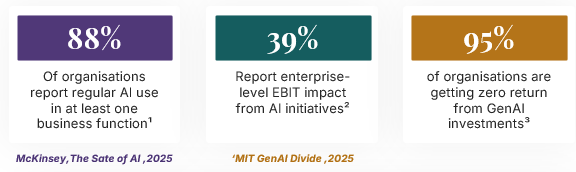
The question leaders should be asking is not ‘How do we implement more AI?’ but ‘What has to change for AI to create sustained performance and competitive advantage?’
The Missing Piece
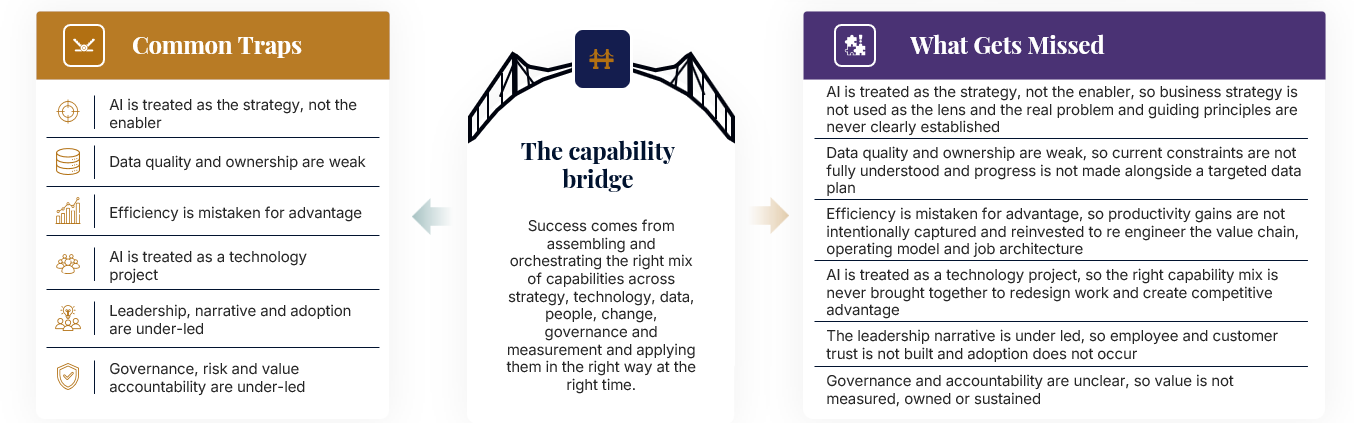
Most AI approaches focus on technology implementation.
What gets missed is the capability system required to turn AI activity into organisational performance.
Success comes from deliberately orchestrating strategy, technology, data, people, change, governance and measurement - and applying them in the right way at the right time.
This is the capability bridge.
The Klease Method Bridges the Gap Between AI Ambition and Business Performance
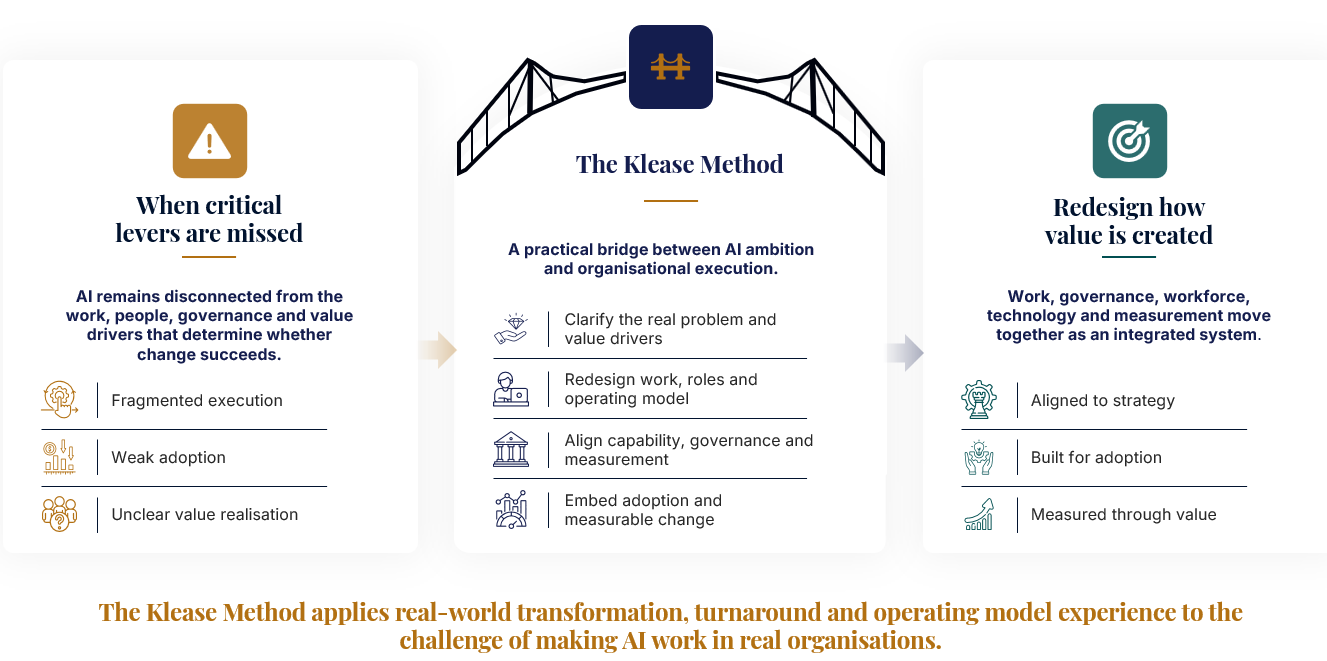
The Klease Method is a practical methodology and governance framework for helping organisations move beyond AI experimentation and create measurable business value, sustained performance and competitive advantage.
By aligning strategy, governance, job design, workforce capability, operating model, technology and measurement, organisations can turn AI activity into measurable performance and competitive advantage
The Klease Method aligns with emerging best practice for AI governance, organisational capability and responsible AI adoption, including principles reflected in the Australian adoption of ISO/IEC 42001 for AI management systems. It helps organisations move beyond AI experimentation to structured, governed and value-driven implementation